
 VALVES
 |
พื้นที่ Side Bar
สามารถแก้ไขได้ที่ระบบ Admin |
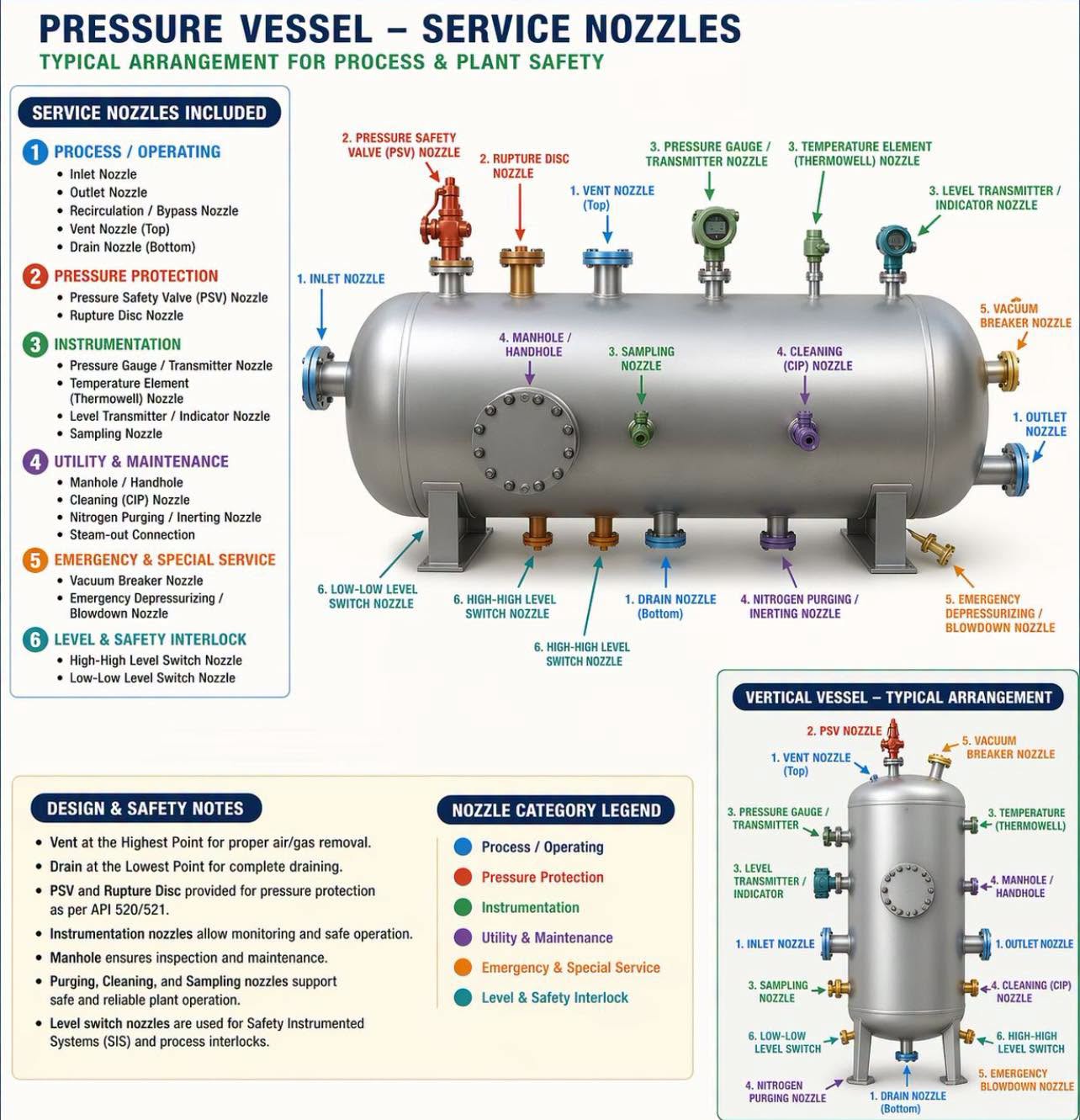
In process & plant safety design, pressure vessel nozzles are not just functional—they are critical for safe operation, inspection, control, and emergency handling. Codes like ASME Boiler and Pressure Vessel Code (Section VIII) and good engineering practices define what service nozzles should be included.
Here’s a practical, safety-focused classification:
 1. Process / Operating Nozzles
These are mandatory for normal operation:
Inlet nozzle – feed entry
Outlet nozzle – product discharge
Recirculation / bypass nozzle (if required)
Drain nozzle – lowest point for complete draining
Vent nozzle – highest point for gas removal.
 Safety note: Improper venting can lead to air pockets or vacuum issues. 2. Pressure Protection Nozzles (Critical for Safety)
These are non-negotiable:
Pressure Safety Valve (PSV) / Relief Valve nozzle
Rupture disc nozzle (optional but common in hazardous service)
Must comply with American Petroleum Institute standards like API 520/521. 3. Instrumentation NozzlesFor monitoring and control:
Pressure gauge / transmitter nozzle
Temperature element nozzle (Thermowell)
Level indicator nozzle (DP / sight glass / radar)
Sampling nozzle
Safety note: Redundancy (dual transmitters) is often used in critical vessels. 4. Utility & Maintenance NozzlesEnsure operability and long-term safety:
Manhole / hand hole – for inspection & entry
Cleaning (CIP) nozzle / flushing connection
Nitrogen purging / inerting nozzle
Steam-out connection (for hydrocarbons service)
5. Emergency & Special Service NozzlesDepending on service:
Vacuum breaker nozzle (to prevent collapse)
Emergency depressurizing / blowdown nozzle
Fire water / spray nozzle (for fire protection in some designs)
6. Level & Safety Interlock NozzlesFor automated safety:
High-high level switch nozzle
Low-low level switch nozzle
Used in SIS (Safety Instrumented Systems). Design Considerations (Very Important)Orientation matters:
Vent → top
Drain → bottom
PSV → vapor space (top)
Accessibility: Instruments and PSVs must be reachable
Dead zones: Avoid nozzle placement that traps fluid
Corrosion allowance: Especially for drain & sampling nozzles
Minimum nozzle count vs safety: Don’t over-minimize at cost of safety
 Typical Minimum Safety Set (Industry Practice)
For most pressure vessels, at least:
Inlet + Outlet
Vent + Drain
PSV nozzle
Pressure + Level measurement
Manhole.

บริษัท ไททั้นอินดัสเทค จำกัด
ที่อยู่ 88/13-14 หมู่ 7 ตำบล สวนหลวง อำเภอ กระทุ่มแบน จังหวัด สมุทรสาคร 74110
โทร : 0-2811-0055 (AUTO), แฟ็กซ์ : 0-2811-0477
เว็บไซต์ : www.titanindustech.com, อีเมล์ : sales1_titanindustech@hotmail.co.th
ที่อยู่ 88/13-14 หมู่ 7 ตำบล สวนหลวง อำเภอ กระทุ่มแบน จังหวัด สมุทรสาคร 74110
โทร : 0-2811-0055 (AUTO), แฟ็กซ์ : 0-2811-0477
เว็บไซต์ : www.titanindustech.com, อีเมล์ : sales1_titanindustech@hotmail.co.th
Hotline : 080-591-0055